energy_mass_balanceequipment_sizingcostingother
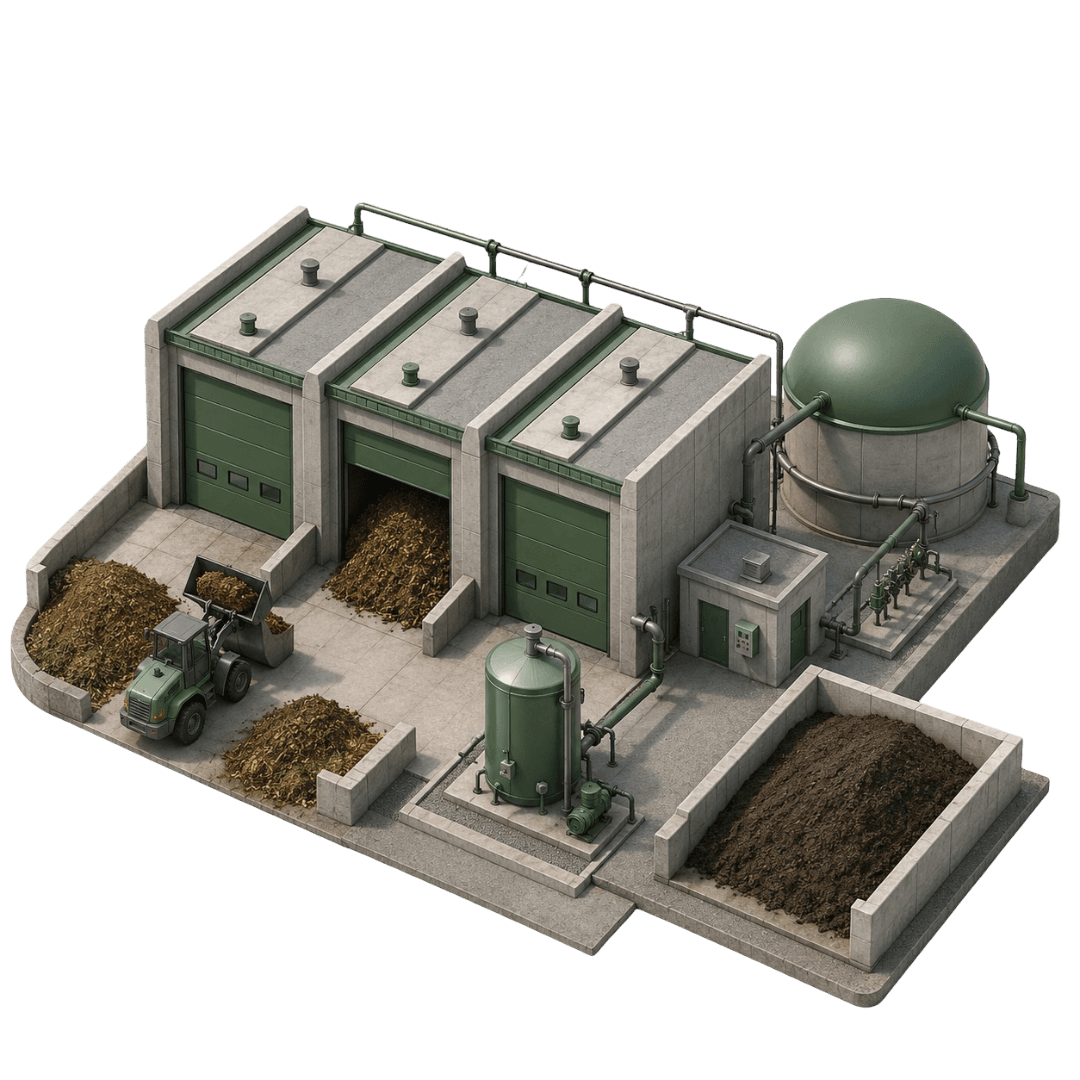
Screening-level mass/energy balance, garage sizing, percolate recirculation loads, CHP capacity, and levelized electricity cost for a dry batch (garage) anaerobic digestion plant.
Total fresh mass treated per year (sum of manure, green waste, biowaste, etc.).
min 0 · max 500000 · step 100 · t/year
Typical dry batch is >20% TS (solid heap).
min 10 · max 60 · step 1 · %
VS/TS of the feedstock mix (dimensionless).
min 0.3 · max 0.95 · step 0.01 · ratio
Typical agricultural AD biogas is often ~50–60% CH4.
min 45 · max 70 · step 1 · %
Project-specific BMP/expected yield on a VS basis.
Select mesophilic or thermophilic; affects heat demand per tonne.
Share of net available heat that can be used/exported (site heat sinks, district heat, etc.).
Fraction of the year the CHP is operating at planned load (availability and dispatch).
Useful volume that can be filled with the solid heap (excluding headspace/gas dome).
min 20 · max 2000 · step 10 · m3
Average apparent density of the substrate pile in the garage.
min 0.3 · max 1.2 · step 0.05 · t/m3
Total occupancy time per batch, including digestion and turnaround (loading/unloading).
min 10 · max 120 · step 1 · days
Total percolate volume recirculated per tonne of fresh feed (screening aggregate).
min 0 · max 3 · step 0.05 · m3/t
Annual biogas production
Biogas volume derived from methane potential and biogas CH4 fraction
Annual methane production
Methane volume from VS and methane yield
Number of garages (digesters)
Parallel batch units required to process annual tonnage with chosen cycle
Installed CHP electrical capacity
Average electric power adjusted by batch peak factor and oversize margin
Net electricity exported
Gross CHP electricity minus auxiliaries (biogas-linked + percolate pumping)
Net heat available after process heating
CHP thermal output minus estimated heating demand (mode-dependent)
Total CAPEX (scaled)
Capacity-based specific CAPEX with economies of scale and a project multiplier
Used for CAPEX annualization (CRF). Enter as a decimal (e.g., 0.08 = 8%).
Levelized cost of electricity (LCOE)
Total annualized cost divided by net exported electricity
Adjusts scaled CAPEX for site complexity, automation level, contingencies, etc.
min 0.7 · max 1.5 · step 0.02 · ratio
Amortization period for annualization (CRF).
Calculator context
This calculator provides a pre-feasibility screening model for dry batch / “garage” anaerobic digestion projects, aligned with the operating scope: number of garages, loading cycle, percolate recirculation, batch gas production profile, heating demand, and installed CHP capacity. It is inspired by the ADEME guidance for discontinuous dry digestion (“voie sèche discontinue”) and uses standard project-finance cost annualization to derive levelized metrics.
The model combines a feedstock-based methane potential with simplified operational factors (availability/part-load penalty) and equipment sizing rules typical for early-stage development.
Key calculations include:
Sources and reference organizations: ADEME (France) for dry batch process characteristics, plus IEA/IRENA/NREL-style screening approaches for efficiencies, scaling, and LCOE formulation.
30 assumptions used in the calculations
Prevents division-by-zero and unstable ratios in screening calculations.
Market range Not applicable
Non-leap year hours used for capacity factor conversion to annual load hours.
Market range 8760
Used to convert annual flows to daily averages and batch cycles per year.
Market range 365
Converts kWh to MWh for consistent annual energy reporting.
Market range 1000
Approximate lower heating value of methane at normal conditions to convert Nm3 CH4 to energy.
Represents a typical mid-scale biogas engine-generator electrical efficiency at/near rated load.
Represents typical recoverable heat fraction from a biogas CHP unit (jacket + exhaust).
Represents non-pumping auxiliary loads proportional to biogas production (controls, mixing where applicable, flare/compression).
Increases effective auxiliary electricity intensity when capacity factor is reduced (start/stop and under-utilization effects).
Prevents unrealistically large auxiliary penalties at very low capacity factor.
Aggregated electricity per m3 of percolate recirculated (accounts for head losses and pump efficiency).
Approximate net process heat required per tonne of fresh feed for mesophilic operation (heating percolate/structure losses).
Higher heat demand per tonne for thermophilic operation due to higher setpoint and typically higher losses.
Captures higher peak-to-average gas rates for a small number of garages; peaks reduce as garages increase.
Limits peak-to-average sizing multiplier to avoid unrealistic capacity requirements at extreme conditions.
Adds a practical margin for engine selection, degradation, and operational flexibility.
Defines the capacity at which the reference specific CAPEX applies for the scaling correlation.
Represents an order-of-magnitude installed CAPEX for a garage-based dry batch AD + CHP system at the reference scale.
Models decreasing specific CAPEX with larger installed capacity.
Market range -0.05 to -0.3
Prevents unrealistically low specific CAPEX from scaling at very large capacities.
Prevents unrealistically high specific CAPEX for very small projects due to scaling extrapolation.
Represents annual fixed O&M as a fraction of total CAPEX (maintenance, labor share, consumables).
Models modest economy of scale in O&M fraction at larger capacities.
Market range -0.15 to 0.0
Avoids unrealistically low O&M fraction for large projects.
Avoids runaway O&M fraction for very small projects due to scaling extrapolation.
Represents variable costs proportional to gross electricity (e.g., engine service hours, consumables).
Improves readability and avoids inline literals for clamps and invalid checks.
Market range 0
Improves readability and avoids inline literals for checks and factors.
Market range 1
Used for validating two-option select inputs.
Market range 2
Used for validating percentage inputs.
Market range 100
1 external source