energy_mass_balanceother
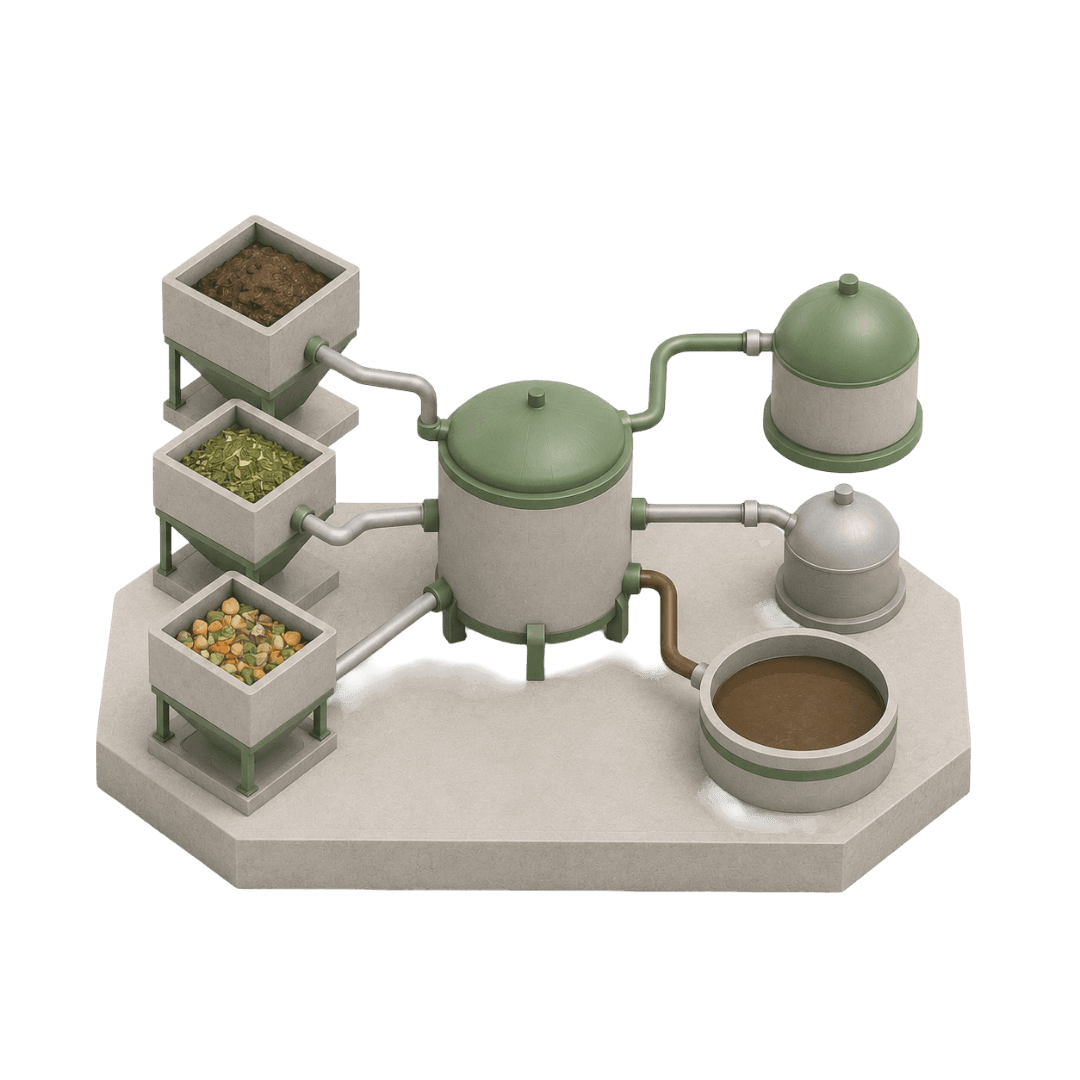
Estimate annual biomethane potential from a mixed feedstock inlet using TS (MS), VS (MV), BMP and biogas CH4 content; outputs biogas, CH4, CO2 and digestate quantity.
Used to scale processed tonnage (downtime, collection limits, commissioning ramp-up).
min 0 · max 100 · step 1 · %
Typical raw biogas CH4 is often ~50–65% vol. Used to split CH4 vs CO2 volumes.
min 1 · max 80 · step 1 · %
Annual wet mass delivered to the digester (before utilisation scaling).
Total solids as % of wet mass.
Volatile solids fraction of TS.
Biochemical methane potential per tonne of volatile solids.
Annual wet mass delivered to the digester (before utilisation scaling).
Total solids as % of wet mass.
Volatile solids fraction of TS.
BMP per tonne of volatile solids.
Annual wet mass delivered to the digester (before utilisation scaling).
Total solids as % of wet mass.
Volatile solids fraction of TS.
BMP per tonne of volatile solids.
Annual wet mass delivered to the digester (before utilisation scaling).
Total solids as % of wet mass.
Volatile solids fraction of TS.
BMP per tonne of volatile solids.
Annual wet mass delivered to the digester (before utilisation scaling).
Total solids as % of wet mass.
Volatile solids fraction of TS.
BMP per tonne of volatile solids.
Total processed feedstock (wet)
After applying utilisation (capacity factor)
Total dry matter (TS/MS)
Annual total solids entering digestion
Total volatile solids (VS/MV)
Annual volatile solids available for biodegradation
Raw biogas produced
Derived from CH₄ and biogas methane content
Methane produced (CH₄)
From VS and BMP
Carbon dioxide produced (CO₂)
Biogas remainder after CH₄ (and trace gases, if enabled)
Energy in produced methane (LHV)
Chemical energy content of CH₄ only
Digestate quantity (wet, screening)
Feedstock wet mass minus biogas mass
Calculator context
This calculator screens the methane potential of an anaerobic digestion feedstock blend (e.g., manure, slurry, CIVE/catch crops, biowaste, industrial effluents) using project-stage inputs typically available during early development. It follows a transparent mass/volume balance approach used in biogas feasibility pre-studies, consistent with common practice in IEA Bioenergy technical reporting and widely cited biogas engineering handbooks.
The model computes volatile solids (VS) from wet tonnage and solids content, then converts VS to methane using BMP, and derives total biogas and CO₂ from an assumed/entered biogas methane content.
Key steps (annual basis):
Default physical properties (gas densities, LHV) are drawn from standard gas data references (e.g., ISO 6976 conventions and NIST-type property tables). BMP remains user-provided because it is highly substrate- and test-dependent.
15 assumptions used in the calculations
Prevents division by zero and unstable calculations when CH4 fraction is very small.
Market range Not applicable
Used to translate capacity factor to equivalent operating hours.
Market range 8760 for non-leap year convention
Converts percent inputs (0–100) to fractions (0–1).
Market range Exact
Avoids inline numeric literals in expressions.
Market range Exact
Avoids inline numeric literals in expressions and supports clamping to non-negative values.
Market range Exact
The energy_mass_balance category requires a load penalty node; for this feedstock BMP calculator the penalty is set to zero so it does not affect results.
Market range 0 (disabled) to ~0.3 (in some part-load penalty models)
Ensures load penalty is not less than 1 in the mandatory clamp() expression.
Market range Typically 1
Set equal to 1 so the load penalty remains 1 (no penalty) for this calculator scope.
Market range 1 to ~2 in some part-load penalty models
Auxiliary energy consumption is not required for the requested outputs; kept at 0 to satisfy mandatory node structure without adding unrelated assumptions.
Market range 0 to ~0.1 kWh/Nm3 (site-dependent, if used)
Requested outputs focus on CH4 and CO2; trace gases (H2S, N2, O2, H2O vapor) are neglected for a first-pass split.
Market range 0 to 0.05 (often small but variable)
Used to convert methane volume (Nm3) to mass for the simplified digestate wet mass balance.
Market range Approximately 0.65–0.75 kg/Nm3 depending on reference conditions
Used to convert CO2 volume (Nm3) to mass for the simplified digestate wet mass balance.
Market range Approximately 1.8–2.1 kg/Nm3 depending on reference conditions
Converts methane volume to chemical energy (LHV) for screening energy potential.
Market range About 9.5–10.2 kWh/Nm3 depending on reference conditions
Converts kilograms to metric tonnes for mass balance outputs.
Market range Exact
Converts kWh to MWh for energy outputs.
Market range Exact